
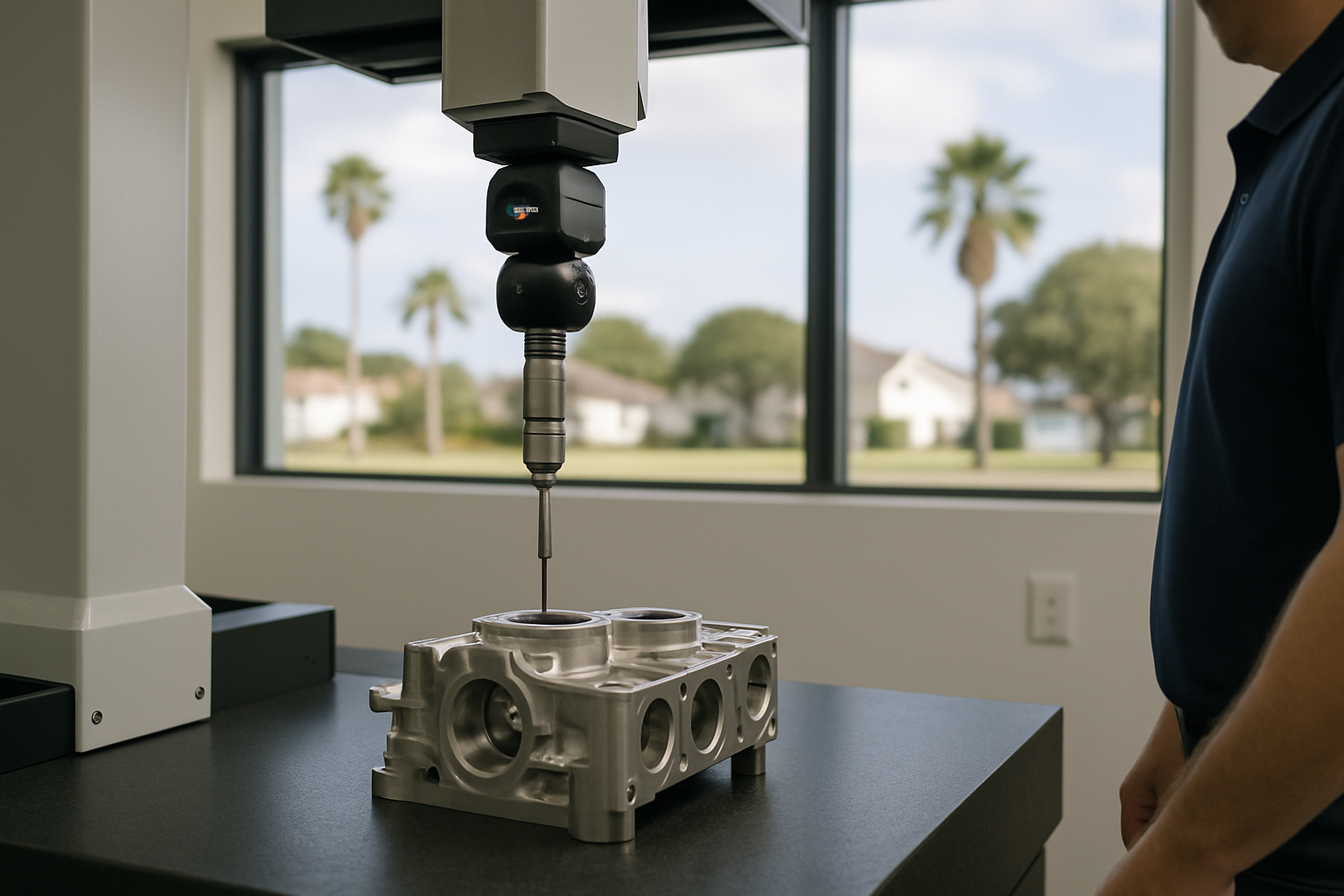
CMM Inspection & First-Article in Flour Bluff, Corpus Christi TX
Flour Bluff (ZIP 78418) sits within the Corpus Christi TX service area. Naval-base community on the south Coastal Bend. Coastal humidity is constant and prevailing winds carry salt air inland. Mixed housing stock from 1960s base-era through 2000s subdivisions.
High PCS (military move-in / move-out) turnover. Move-in / move-out scheduling is common, and military discount expectations are typical.
For cmm inspection & first-article, the service area covers roughly 200 miles from central Corpus Christi.
Common reasons to call
- First-article inspection on a new part run
- PPAP submission package for an automotive or aerospace customer
- Dimensional report on a rejected lot before disposition
- Incoming inspection on critical purchased parts
- Reverse engineering a part with no current drawing
- Periodic process capability check on production parts
- Source inspection at the supplier before shipment
- Surface plate work backed up by CMM verification
- GD&T verification on a complex feature
- Calibration cross-check between gauges and the part datum
Typical work
- Program a CMM routine from the drawing or model
- Probe critical features and capture true position, profile, runout, and form
- Write the inspection report with measured value, tolerance, and result per feature
- Build a PPAP package including dimensional results, control plan, and PFMEA references where requested
- Capture scan data on complex surfaces and compare to a CAD model
- Reverse-engineer features and deliver a drawing package
- Document non-conforming features with photos and measurement traceability
Typical turnaround
Single-part dimensional checks are commonly same-day or next business day. Full first-article inspection and PPAP packages typically deliver within two to seven business days depending on feature count and customer format. Recurring programs run on the production cadence.
Materials and equipment
- CMM probe heads, styli, and reference spheres
- Granite or steel surface plate, parallels, and clamps
- Calibration artifacts and traceable gauge blocks
- Inspection software for GD&T evaluation and report formatting
- CAD model import for scan and probe comparison
- Controlled inspection room with temperature and humidity monitoring
Job sizes
Minor
Single-part dimensional check with summary report
Standard
First-article inspection of a new part with full dimensional report
Major
PPAP submission package or multi-part lot inspection with traceability
Replacement
Programmed periodic inspection on a recurring production part
Final pricing comes from the on-call provider after on-site assessment, with a written estimate before any work starts.
What to expect
- ✓NIST-traceable calibration of CMM and artifacts
- ✓ASME Y14.5 GD&T evaluation supported by the inspection software
- ✓ISO 9001 quality system used to control the inspection process
- ✓Customer-specific quality flowdown honored for aerospace, automotive, and oilfield customers
- ✓Controlled inspection room reduces temperature and humidity influence on measurement
ASQ certifications such as CQI or CQT, manufacturer training on the specific CMM platform, GD&T training to ASME Y14.5, ISO 9001 quality system at the shop, NIST-traceable calibration of artifacts, customer-specific quality approvals for aerospace, automotive, or oilfield customers.
Common questions
What is a CMM and what does it measure?
A coordinate measuring machine probes features on a part and reports measured locations in three dimensions. It is used to verify dimensions, geometric tolerances, and surface profiles against a drawing or CAD model.
What is a first-article inspection?
First-article inspection (FAI) is a full dimensional verification on the first part of a new production run, or the first part after a process change. It documents that the process is making parts to print before production volume runs.
What is PPAP?
PPAP stands for Production Part Approval Process. It is the package of documents and measurements that an automotive or aerospace customer requires before approving a supplier for production parts. The CMM dimensional results are one piece of that package.
Do you handle aerospace or automotive customers?
Shop capability varies. Aerospace customers commonly require AS9100, automotive customers commonly require IATF 16949. Confirm the customer's quality flowdown when scheduling, and the package will follow that format.
Can you reverse-engineer a part?
Yes. With the original part in hand, calibrated probing or scanning recreates the feature geometry. A drawing or CAD model can be delivered along with the dimensional report.
Do you check GD&T features like true position and profile?
Yes. The CMM software evaluates the feature against the datum reference frame stated in the drawing, per ASME Y14.5.
How traceable is the report?
Calibration of the CMM and its artifacts is traceable to NIST. Reports include the calibration reference and the inspection date so the customer can verify traceability.
Can you inspect parts that are too large for your machine?
Portable arm and laser tracker partners are often used for parts larger than the CMM envelope. Surface plate work supplements the CMM where appropriate.
Coastal Bend seasons
Spring (March - May)
New program launches and supplier approvals concentrate in spring as production budgets release.
Summer (June - August)
Aerospace and oilfield production volume drives recurring inspection cycles.
Fall (September - November)
Year-end audits and customer surveillance audits push first-article and PPAP refresh work.
Winter (December - February)
Lower production volume opens capacity for reverse engineering and discretionary capability studies.