
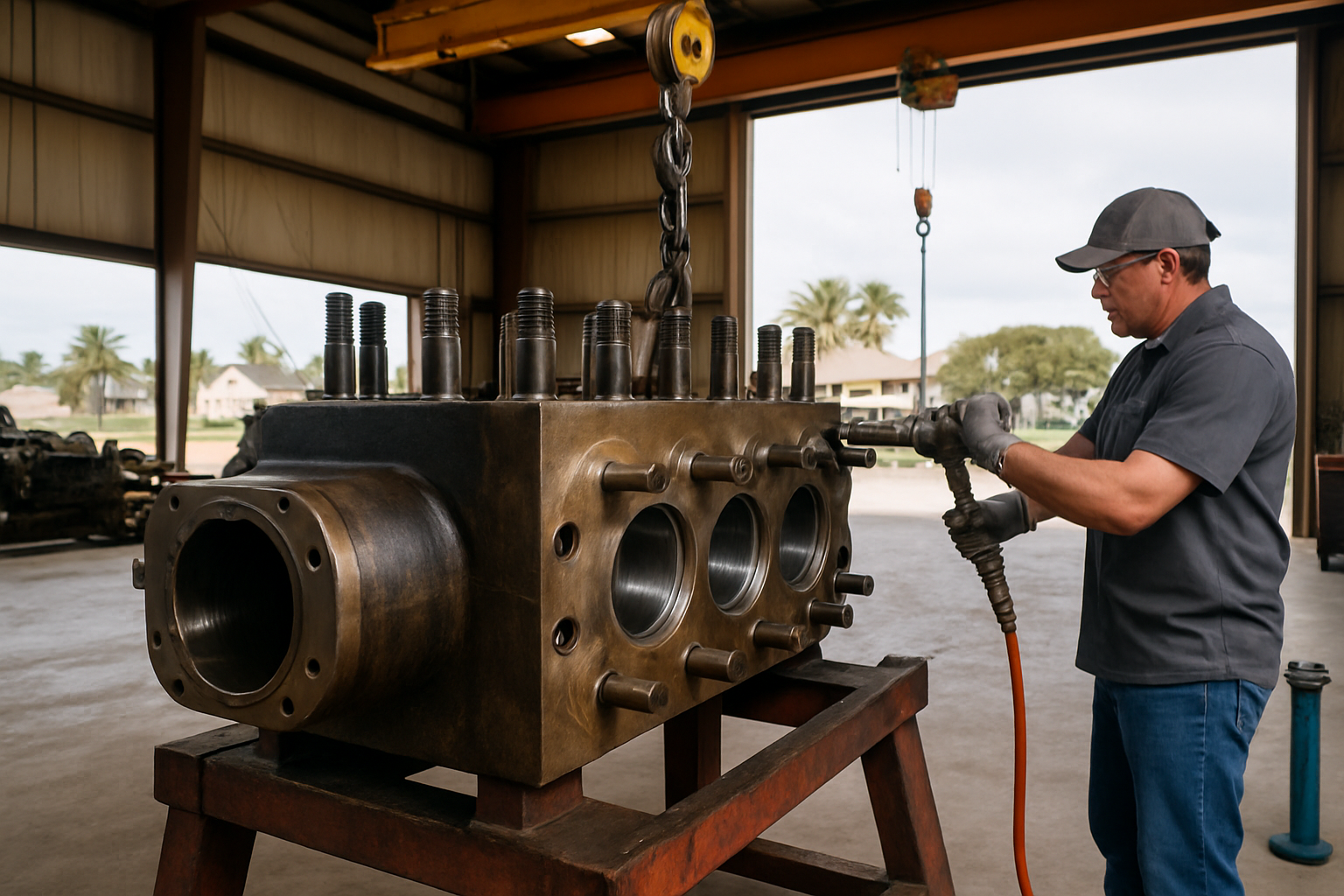
Frac Pump Service & Tools in Westside, Corpus Christi TX
Westside (ZIP 78405) sits within the Corpus Christi TX service area. Established working-class to middle neighborhoods adjacent to the central hospital district. Older housing stock from the 1940s through 1970s with later infill. Mature tree canopy.
Hospital-district adjacency means daytime traffic and parking pressure during business hours. Easier scheduling on evenings and weekends.
For frac pump service & tools, the service area covers roughly 200 miles from central Corpus Christi. Urgent requests can be submitted any time; response time depends on the local provider.
Common reasons to call
- Fluid end rebuild or replacement on a high-pressure frac pump
- Power end inspection, bearing check, and crosshead service
- Plunger and packing change between stages
- Valve, seat, and spring expendables supply
- Suction and discharge manifold service
- Pressure test and certification on rebuilt assemblies
- Field service call for a pump down on location
- Tooling, wrenches, and shop fixtures for frac pump work
- Coiled tubing pump and cement pump service
- Asset inspection before a job cycle
Typical work
- Disassemble, inspect, and rebuild a fluid end
- Power end pull, crank, bearing, and crosshead inspection
- Plunger and packing swap with leak test
- Valve and seat lap or replace, spring inspection
- Pressure cycle test to rated working pressure
- Hydrostatic test of high-pressure piping
- Sell, ship, or stage expendable parts for the next job
- Reverse-engineer or machine tooling fixtures for shop or yard work
Typical turnaround
Plunger and packing service is commonly same-day at the yard. Fluid end rebuilds turn within two to five business days depending on parts on hand. Power end work and assembly replacement follow the operator's spread schedule and parts lead time.
Materials and equipment
- Frac pump fluid ends, plungers, packing, valves, seats, and springs
- Studs, nuts, retainers, and discharge flange hardware
- High-pressure test equipment with calibrated gauges
- Specialty wrenches, valve-seat pullers, and hydraulic torque tools
- Slings, lifting eyes, and rigging rated for fluid end weight
- Inspection forms, torque records, and pressure test certificates
Job sizes
Minor
Single plunger and packing change or valve and seat swap
Standard
Full fluid end rebuild on one pump with pressure test
Major
Power end pull and inspection, multi-pump program at the yard or location
Replacement
Full assembly replacement, complete pump exchange, or unit refresh program
Final pricing comes from the on-call provider after on-site assessment, with a written estimate before any work starts.
What to expect
- ✓OSHA 10 or 30 and H2S Clear training carried for field crew
- ✓Operator orientation completion and TWIC available where required
- ✓Pressure test certificate and torque records delivered with rebuilds
- ✓OEM service training honored on the supported pump models
- ✓Lifting and rigging training, with rated slings and fixtures, used on every assembly handle
OSHA 10 or 30 general industry, H2S Clear, SafeLand or SafeGulf operator-specific orientation, TWIC where required, manufacturer service training from common pump OEMs, lifting and rigging training, general liability and operator-required additional insured coverage.
Common questions
What is a fluid end versus a power end?
The fluid end is the high-pressure section that contacts the frac fluid through plungers, packing, valves, and seats. The power end is the mechanical drive section with crank, bearings, and crossheads. The two are serviced on different intervals.
How often does packing need to be changed?
Packing life depends on fluid, sand load, pressure, and rate. Many crews change packing every stage or every few stages. The bid reflects the operator's program and the condition observed.
Do you carry expendables on hand?
Common plungers, packing kits, valves, seats, and springs for the major OEM pump models are stocked. Less common parts are sourced on a project lead time.
Can you test the pump after the rebuild?
Yes. A rebuilt fluid end is pressure-cycled on a test stand and the report includes the test pressure, hold time, and a torque record for the discharge studs.
Do you go to location?
Yes, with the right safety qualifications, operator orientation, and JSA paperwork. H2S Clear, SafeLand or SafeGulf, and TWIC are common requirements.
What pump brands and models do you service?
Most common frac pump platforms in the South Texas market. Specific OEM coverage depends on the shop's training. Ask before scheduling to confirm parts and tooling.
Can you supply tooling and shop fixtures?
Yes. Specialty wrenches, valve-seat tools, fluid end stands, and lifting fixtures can be supplied, machined, or repaired. Reverse engineering is available where the OEM print is not on hand.
Do you handle coiled tubing and cement pumps?
Yes. The service scope is similar with different rated pressures and packing styles. The bid reflects the specific pump and operator program.
Coastal Bend seasons
Spring (March - May)
Spring activity ramp brings asset prep at the yard and rebuild backlogs.
Summer (June - August)
Peak hot weather and continuous operations stress packing and seats. Field service volume rises.
Fall (September - November)
Budget close drives planned rebuilds before year end.
Winter (December - February)
Quieter on-location season is the window for power end pulls and major program work at the yard.